RACI matrix
Category: Project Management
What are RACI charts?
A RACI chart (also known as RACI matrix or RACI model) is a project management tool that uses a matrix (table) to clearly define and communicate the roles and responsibilities of all participants in a given process or project.
The main goal of RACI is to eliminate confusion and ensure nothing is missed by assigning a clear role to each person for each specific task or activity.
Meaning of the RACI acronym
The RACI acronym consists of four key roles:
- R = Responsible (Executor)
Who performs the actual work.
This is the person or team who actually EXECUTES the task.
For one task, there can be several "R" (e.g., several engineers coding one module).
- A = Accountable (Responsible/Approver)
Who bears ultimate responsibility for the correct and timely completion of the task.
This is the person who approves (gives "go-ahead") the work done by the "Executors".
This is the only role with a strict "one-per-task" rule. There should always be only one "A" for one task. This person is the "unity of command point".
- C = Consulted
Who is consulted before making a decision or taking action.
These are people whose opinion is sought, usually due to their experience or expertise.
Communication with them is two-way (e.g., interview, discussion).
- I = Informed
Who is informed after a decision is made or action is taken.
These people need to be informed about progress or results, but don't actively participate in execution or decision-making.
Communication with them is one-way (e.g., email notification, chat message).
How to create a RACI matrix?
- Identify activities: List all key tasks, activities, or decisions from the project or process on the vertical axis (rows) of the table.
- Identify participants: List all roles (or specific people, but roles are preferred) on the horizontal axis (columns) of the table.
- Fill the matrix: For each task, assign one of the letters (R, A, C, I) at the intersection with the corresponding role.
- Review and validate: The matrix is shared and discussed with the team and stakeholders to ensure everyone agrees with the role distribution.
Example RACI matrix for website maintenance
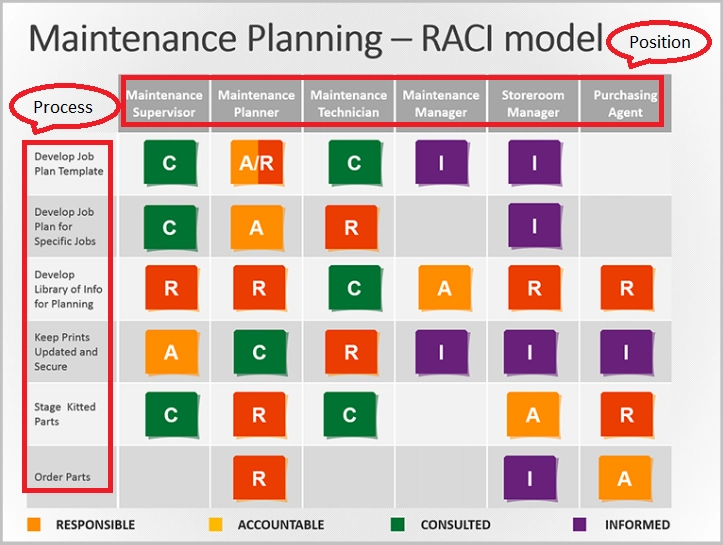
Rules and best practices
- There is always only one "A" (Accountable) per task. If you have more than one, this leads to confusion in responsibility.
- The combination "R" and "A" should not be assigned to the same person for the same task. They cannot approve their own work.
- Not every role needs to have a letter for every task. If there's no connection, the cell should remain empty.
- Avoid too many "C" and "I". This can slow down the process. Ask yourself: "Does this person really need to be consulted/informed about this specific task?".
- Focus on roles, not specific people. This makes the chart more stable and resilient to personnel changes.
Advantages of using RACI
- Clarity and transparency: Everyone knows what's expected of them.
- Reducing duplication: It's clear who does what, which prevents waste of time and resources.
- Improved communication: Shows whom to consult and whom to inform.
- Effective decision-making: It's clear who has the final say ("A").
- Easy onboarding of new people: New team members can quickly understand their responsibilities.
Common problems (pitfalls)
- Too many "R" for one task: This can scatter responsibility. If there are many executors, it's good to appoint one of them as a "lead executor".
- Missing "A": The task has no "owner" and can easily be neglected.
- Creating a matrix and then forgetting it: RACI should be a living document that is reviewed and updated regularly.